

Threshold™ is LGE's framework for detection capability. It is a way of seeing, building, and proving whether a program does what its owners believe it does. Its operating model is the Detection Readiness Cycle™.
Federal guidance gives operators a baseline. It is broad, standardized, and built to serve thousands of sites at once. That is exactly what it should be. But a baseline was never meant to account for your environment, your operators, or the way an incident actually unfolds on your ground. That is the work we do: turning the baseline into capability that holds up under real conditions.
Threshold is the specialist layer that sits on top of that baseline. It does not replace anyone's guidance, internal program, or federal relationships. It tests them against reality and closes the distance between them and genuine capability.
The operating model
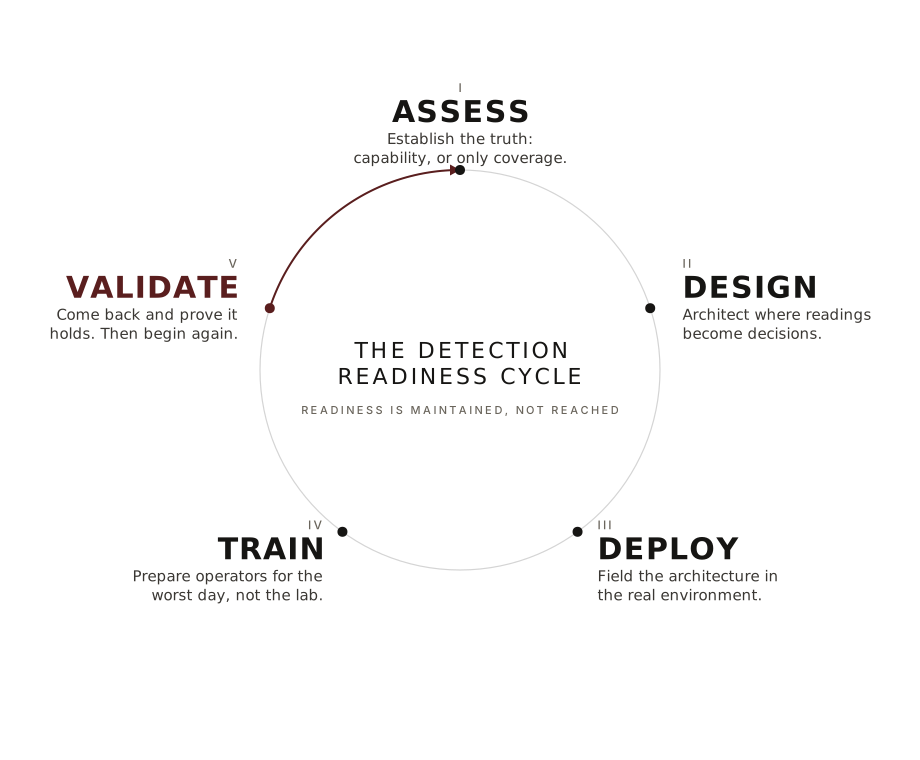
The Detection Readiness Cycle
Capability is not a purchase. It is a sequence of disciplines, each of which can quietly fail. The Cycle is how we work through them, and how we return to them, because a program that was capable last year may not be capable today.
The five disciplines
Assess
We begin by establishing the truth: does this program deliver capability, or coverage? We examine the instruments, the placement, the operators, and the decisions the program is meant to produce, under the conditions it would actually face rather than the conditions it was specified for. Most engagements begin here, and most surprises surface here.
Design
We architect where detection belongs: static and dynamic assets, positioned for the environment, the threat picture, and the way the site actually operates. Coverage is a map of where instruments are. Architecture is a plan for where readings become decisions.
Deploy
We field the architecture we design. A plan that cannot survive contact with a real site, real staffing, and real operating tempo is not a plan. We are in the environment for this, not advising from a distance.
Train
A manufacturer can teach an operator to use an instrument in a laboratory. We prepare operators to use it on their worst day: under time pressure, with imperfect information, when the reading is ambiguous and the decision still has to be made. This is where lab competence becomes real-world capability.
Validate
We come back and prove it works. We test the program against the conditions it exists to meet, and we report plainly where it holds and where it does not. Programs that pass inspection still fail validation, and that gap is the most valuable thing we measure. Validation is not the end of the Cycle. It is the point at which it begins again.
Assess. Design. Deploy. Train. Validate. Then assess again.
Readiness drifts. Staff turn over, sites change, threats evolve, equipment ages. A program is not made capable once. It is kept capable, or it is not capable for long.
Where it applies
The discipline does not change with the setting. Coverage and capability diverge the same way whether the asset is a facility, a network of sites, or the protective environment around the people and assets that matter most. Wherever detection has to perform under real conditions, the questions Threshold asks are the same.
Start here
Start by finding out where you stand.
An assessment is the entry point to Threshold, and it stands on its own. It is a structured test of the program you already have, your instruments, your people, your decisions, measured against real conditions rather than specifications. Many organizations expect to confirm that their program is sound. The ones who learn otherwise are glad they did before it mattered.
It is the least expensive way to know whether you have capability or only coverage. If what you have is sound, you will know it. If it is not, you will know that too, while there is still time and budget to act.